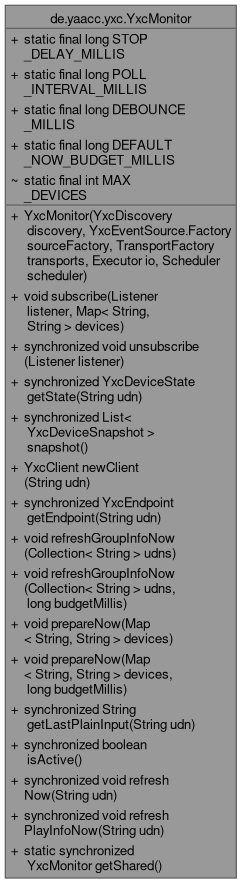
Keeps the YxcDeviceState of the devices that speak the protocol up to date for the receiver row.
More...
Classes | |
| interface | Cancellable |
| interface | Listener |
| interface | Scheduler |
| interface | TransportFactory |
Public Member Functions | |
| YxcMonitor (YxcDiscovery discovery, YxcEventSource.Factory sourceFactory, TransportFactory transports, Executor io, Scheduler scheduler) | |
| void | subscribe (Listener listener, Map< String, String > devices) |
| Registers the listener and watches the devices. | |
| synchronized void | unsubscribe (Listener listener) |
Removes the listener; the last one leaving stops the monitor after STOP_DELAY_MILLIS. | |
| synchronized YxcDeviceState | getState (String udn) |
| synchronized List< YxcDeviceSnapshot > | snapshot () |
| YxcClient | newClient (String udn) |
| synchronized YxcEndpoint | getEndpoint (String udn) |
| void | refreshGroupInfoNow (Collection< String > udns) |
| Reads the group information of the given devices now, on the calling thread, whether the monitor runs or not. | |
| void | refreshGroupInfoNow (Collection< String > udns, long budgetMillis) |
Like refreshGroupInfoNow(Collection), but no device is started on once the budget is used up (one that is under way finishes within the transport's own limits). | |
| void | prepareNow (Map< String, String > devices) |
| Makes sure the given devices are watched and, for the ones not looked at yet, finds out on the calling thread whether they speak the protocol. | |
| void | prepareNow (Map< String, String > devices, long budgetMillis) |
Like prepareNow(Map); no device is looked at once the budget is used up. | |
| synchronized String | getLastPlainInput (String udn) |
| synchronized boolean | isActive () |
| synchronized void | refreshNow (String udn) |
| Asks for a complete read of one device now, for example after the app changed something on it. | |
| synchronized void | refreshPlayInfoNow (String udn) |
| Asks for the play info of one device now (the network source and, on the tuner input, the tuner), for example while a tuner scan runs: the tuner's own events are not used (they flood). | |
Static Public Member Functions | |
| static synchronized YxcMonitor | getShared () |
| The app-wide monitor with the real network, threads and clock. | |
Static Public Attributes | |
| static final long | STOP_DELAY_MILLIS = 30_000L |
| static final long | POLL_INTERVAL_MILLIS = 30_000L |
| static final long | DEBOUNCE_MILLIS = 500L |
| static final long | DEFAULT_NOW_BUDGET_MILLIS = 5_000L |
The time a send gives the reads that decide where it goes (prepareNow, refreshGroupInfoNow). | |
Detailed Description
Keeps the YxcDeviceState of the devices that speak the protocol up to date for the receiver row.
Lifetime. Everything runs only while somebody is subscribed (a sheet or the receiver tab on screen). The UDP event source is opened with the first subscriber and closed STOP_DELAY_MILLIS after the last one left, so switching between the tab and the sheet does not close and reopen it; polling stops at the same time.
Reading. A device is first looked at by YxcDiscovery (once per UDN); only devices that speak the protocol are ever talked to again. Every POLL_INTERVAL_MILLIS all of them are read completely: that is the fallback when events do not arrive (a firewall, a device that dropped the registration) and it renews the registration, which every request carries. Events are applied at once when they carry the value (power, volume, mute, input); flags that only say "changed" ask for a read of the matching call, after DEBOUNCE_MILLIS without a further such event, so a burst of five datagrams makes one read.
Trust. An event counts only when it comes from the address of a device found by our own discovery and, if it names a device_id, the one of that device. Everything else is dropped.
Threads. The listeners are called on a worker or scheduler thread, never with the lock held; a listener that touches views posts to the main thread. The clock, the threads and the network are injected so the behavior is tested on the JVM without waiting.
Member Function Documentation
◆ getEndpoint()
| synchronized YxcEndpoint de.yaacc.yxc.YxcMonitor.getEndpoint | ( | String | udn | ) |
- Returns
- the endpoint of a watched device that speaks the protocol,
nullfor any other
Referenced by de.yaacc.yxc.YxcMonitorEnvironment.members().

◆ getLastPlainInput()
| synchronized String de.yaacc.yxc.YxcMonitor.getLastPlainInput | ( | String | udn | ) |
- Returns
- the last input of the device that was not the link input,
nullif it was never seen
Referenced by de.yaacc.yxc.YxcMonitorEnvironment.lastPlainInput().

◆ getState()
| synchronized YxcDeviceState de.yaacc.yxc.YxcMonitor.getState | ( | String | udn | ) |
- Returns
- the last state of a watched device that speaks the protocol,
nullfor any other
◆ isActive()
| synchronized boolean de.yaacc.yxc.YxcMonitor.isActive | ( | ) |
- Returns
- whether the events are being received right now (for tests and diagnostics)
◆ newClient()
| YxcClient de.yaacc.yxc.YxcMonitor.newClient | ( | String | udn | ) |
- Returns
- a client for a watched device that speaks the protocol,
nullfor any other. It sends no event port, so it does not change what the device pushes to the monitor.
Referenced by de.yaacc.yxc.YxcMonitor.refreshGroupInfoNow().

◆ prepareNow()
| void de.yaacc.yxc.YxcMonitor.prepareNow | ( | Map< String, String > | devices | ) |
Makes sure the given devices are watched and, for the ones not looked at yet, finds out on the calling thread whether they speak the protocol.
For a send that is decided before any screen has subscribed (the selection of receivers is stored, the monitor starts empty). Does not start polling or the event source. Blocks for the time of the description fetches (bounded; a verdict is remembered).
- Parameters
-
devices UDN to the URL the registry fetched its description from
Referenced by de.yaacc.yxc.YxcMonitor.prepareNow().
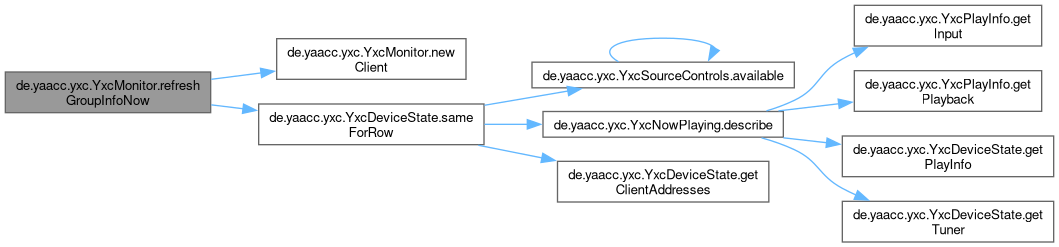
◆ refreshGroupInfoNow() [1/2]
| void de.yaacc.yxc.YxcMonitor.refreshGroupInfoNow | ( | Collection< String > | udns | ) |
Reads the group information of the given devices now, on the calling thread, whether the monitor runs or not.
For the moment a send is decided: the last state of a device may be older than the last change of the group. Devices that are not watched or do not speak the protocol are skipped; one that does not answer is marked unreachable. Blocks for at most the time of the transport's timeouts per device.
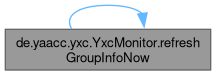
Referenced by de.yaacc.yxc.YxcMonitor.refreshGroupInfoNow().
◆ refreshGroupInfoNow() [2/2]
| void de.yaacc.yxc.YxcMonitor.refreshGroupInfoNow | ( | Collection< String > | udns, |
| long | budgetMillis ) |
Like refreshGroupInfoNow(Collection), but no device is started on once the budget is used up (one that is under way finishes within the transport's own limits).
A send must not wait minutes for slow devices.
◆ refreshPlayInfoNow()
| synchronized void de.yaacc.yxc.YxcMonitor.refreshPlayInfoNow | ( | String | udn | ) |
Asks for the play info of one device now (the network source and, on the tuner input, the tuner), for example while a tuner scan runs: the tuner's own events are not used (they flood).
Cheaper than refreshNow.
◆ snapshot()
| synchronized List< YxcDeviceSnapshot > de.yaacc.yxc.YxcMonitor.snapshot | ( | ) |
- Returns
- the watched devices that speak the protocol and were read at least once, with their last states; the view the group logic works on
Referenced by de.yaacc.yxc.YxcMonitorEnvironment.members().

◆ subscribe()
| void de.yaacc.yxc.YxcMonitor.subscribe | ( | Listener | listener, |
| Map< String, String > | devices ) |
Registers the listener and watches the devices.
Devices already watched are not read again at once, new ones are; if the monitor had stopped, everything is read again (events were missed).
- Parameters
-
devices UDN to the URL the registry fetched its description from
The documentation for this class was generated from the following file:
- /github/workspace/yaacc/src/main/java/de/yaacc/yxc/YxcMonitor.java
Generated by
 1.12.0