de.yaacc.share.ByteRangeResolver Class Reference
Turns the Range header of a request into the one answer a single-range server gives: status 200, 206 or 416, the bytes to send and the Content-Range text.
More...
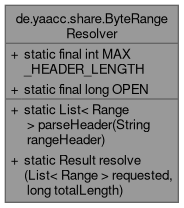
Collaboration diagram for de.yaacc.share.ByteRangeResolver:
Classes | |
| class | Range |
| One requested range, immutable. | |
| class | Result |
| The answer for one request, immutable. | |
Static Public Member Functions | |
| static List< Range > | parseHeader (String rangeHeader) |
Parses the raw Range header value. | |
| static Result | resolve (List< Range > requested, long totalLength) |
| Resolves the requested ranges against the resource length. | |
Detailed Description
Turns the Range header of a request into the one answer a single-range server gives: status 200, 206 or 416, the bytes to send and the Content-Range text.
Plain Java (no android.*), long arithmetic only, and nothing here throws for any input: the header is attacker-controlled.
Decisions (RFC 9110 section 14):
-
No usable
Rangeheader gives 200 with the whole resource and noContent-Range. "Not usable" means: null, empty, a unit other thanbytes(compared ignoring ASCII case), or a syntactically invalid header (a malformed piece, a range whose last position is below its first, a header longer thanMAX_HEADER_LENGTH). An invalid header is IGNORED, never answered with 416. -
A syntactically valid header that selects nothing gives 416 with
bytes */len: the first position is at or beyond the length, a suffix of length 0, or any range on an empty resource (also a suffix: nothing to select). - More than one range is not served (no multipart/byteranges): 200 with the whole resource.
-
A satisfiable single range gives 206, also when it covers the whole resource (
bytes 0-999/1000). A last position at or beyond the length is clipped tolength - 1; a suffix longer than the resource gives everything from 0. -
Digits that overflow
longsaturate atLong#MAX_VALUE(they only ever mean "far beyond any length"); they never throw. -
An unknown (negative) total length cannot be ranged: 200,
length()is -1. -
The header may have leading and trailing spaces or tabs (and only those: a line break or other control character makes it invalid). List elements are separated by commas with optional spaces or tabs around them; empty elements are ignored (RFC 9110 5.6.1.2); whitespace anywhere else (inside
0-99, after=) makes the header invalid. Digits are ASCII only, leading zeros are fine.
Member Function Documentation
◆ parseHeader()
|
static |
Parses the raw Range header value.
Never throws, never returns null.
- Parameters
-
rangeHeader the header value, may be null
- Returns
- the requested ranges in header order; EMPTY (= serve 200 and ignore the header) for null, empty, a unit other than
bytes, a header longer thanMAX_HEADER_LENGTH, a header without any range (bytes=,bytes=,) and ANY syntactically invalid piece (the whole header is then ignored, e.g.bytes=0-9,xorbytes=10-5). Numbers that overflowlongsaturate atLong#MAX_VALUE.
◆ resolve()
|
static |
Resolves the requested ranges against the resource length.
Never throws.
- Parameters
-
requested the ranges from parseHeader(String); null or empty means no range (200, whole resource); more than one range, a null element or an invalid range (Range#isValid()) also gives 200 with the whole resourcetotalLength the length of the resource in bytes; negative means unknown (200)
The documentation for this class was generated from the following file:
- /github/workspace/yaacc/src/main/java/de/yaacc/share/ByteRangeResolver.java
Generated by
 1.12.0