The play queue of an OpenHome playlist: tracks in an order, each with an id that is never used twice (a counter from 1; a deleted track's id does not come back soon, so a control point that still holds it cannot hit another track by mistake). More...
Classes | |
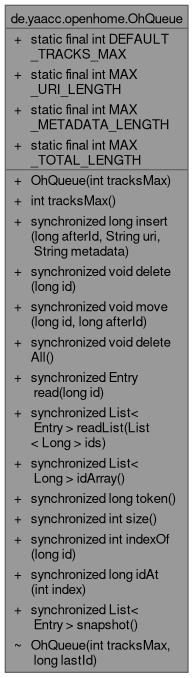
| class | Entry |
| One track of the queue. | |
Public Member Functions | |
| OhQueue (int tracksMax) | |
| int | tracksMax () |
| synchronized long | insert (long afterId, String uri, String metadata) |
| Puts a track into the queue. | |
| synchronized void | delete (long id) |
| synchronized void | move (long id, long afterId) |
| Moves a track to the place behind another one; the id stays. | |
| synchronized void | deleteAll () |
| synchronized Entry | read (long id) |
| synchronized List< Entry > | readList (List< Long > ids) |
| The tracks of the ids that are in the queue, in the order of the ids asked for; others are skipped. | |
| synchronized List< Long > | idArray () |
| synchronized long | token () |
A number that changes with every edit of the queue: the token of the IdArray. | |
| synchronized int | size () |
| synchronized int | indexOf (long id) |
| synchronized long | idAt (int index) |
| synchronized List< Entry > | snapshot () |
Detailed Description
The play queue of an OpenHome playlist: tracks in an order, each with an id that is never used twice (a counter from 1; a deleted track's id does not come back soon, so a control point that still holds it cannot hit another track by mistake).
The queue is the model only: Insert puts a track after another one (or at the start), the edits change the token(), which a control point uses to see that its copy of the IdArray is old. The limits are checked here (number of tracks, length of address and metadata), so nothing a control point sends can make the queue grow without bound. Thread safe.
Member Function Documentation
◆ delete()
| synchronized void de.yaacc.openhome.OhQueue.delete | ( | long | id | ) |
- Exceptions
-
OhError 800 if the id is not in the queue
◆ idAt()
| synchronized long de.yaacc.openhome.OhQueue.idAt | ( | int | index | ) |
- Exceptions
-
OhError 802 if there is no track at the position
Referenced by de.yaacc.upnp.server.openhome.OpenHomeRenderer.trackDeleted().

◆ indexOf()
| synchronized int de.yaacc.openhome.OhQueue.indexOf | ( | long | id | ) |
- Returns
- the position of the track, -1 if it is not in the queue
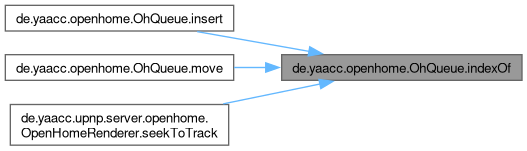
Referenced by de.yaacc.openhome.OhQueue.insert(), de.yaacc.openhome.OhQueue.move(), and de.yaacc.upnp.server.openhome.OpenHomeRenderer.seekToTrack().
◆ insert()
| synchronized long de.yaacc.openhome.OhQueue.insert | ( | long | afterId, |
| String | uri, | ||
| String | metadata ) |
Puts a track into the queue.
- Parameters
-
afterId the track it follows, OhIds#NONEfor the start of the queueuri the address; not empty, at most MAX_URI_LENGTHcharactersmetadata the DIDL-Lite text of the track; may be empty, at most MAX_METADATA_LENGTHcharacters
- Returns
- the id of the new track
- Exceptions
-
OhError 800 if afterIdis not in the queue, 801 if the queue is full, 402 for an address or metadata that is empty or too long

◆ move()
| synchronized void de.yaacc.openhome.OhQueue.move | ( | long | id, |
| long | afterId ) |
Moves a track to the place behind another one; the id stays.
- Parameters
-
afterId the track it follows, OhIds#NONEfor the start of the queue
- Exceptions
-
OhError 800 if one of the ids is not in the queue

◆ read()
| synchronized Entry de.yaacc.openhome.OhQueue.read | ( | long | id | ) |
- Exceptions
-
OhError 800 if the id is not in the queue
The documentation for this class was generated from the following file:
- /github/workspace/yaacc/src/main/java/de/yaacc/openhome/OhQueue.java
Generated by
 1.12.0